 |
| X-ray of a dislocated elbow. This dislocation was caused by a fall from a horse. No fractures occurred. (Photo credit: Hailey Scola) |
This paper discusses the causes and possible solutions for a dislocated elbow. Dislocated elbows are common in car crashes and falls when the person lands on an arm trying to catch themselves. The first section discusses the anatomy of the elbow and how a dislocated elbow can happen. The ulna can push past the humerus and the hinge joint is unable to work properly. Additionally a possible redesign of the elbow to prevent dislocation, so the ulna can be stopped by the humerus instead of sliding past. Prevention techniques are given to prevent a dislocation in daily life. This paper is to inform about the causes and prevention of a dislocated elbow.
 |
| The anatomy of the elbow joint (915 Elbow Joint) |
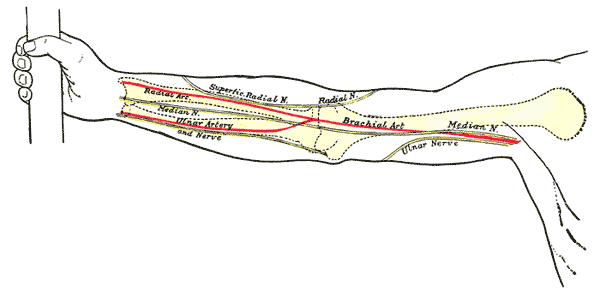 |
| Nerves and arteries in the arm. In car crashes, when the dislocation is possibly paired with fractures, these may be damaged and cause permanent damage or loss of the arm. |
The elbow is where the humerus meets the radius and ulna. I will be focusing on the humeroulnar dislocation. In a dislocation, one of the bones comes out of alignment with the humerus. This often happens when an impact to the hand of an arm that is straightened, coming from a fall or a car crash where the person puts their arms out to catch themselves. This sends a force up through the forearm that can shift the bones in the elbow. The elbow is wrapped in ligaments to help support it and keep the bones bound together. The ligaments can be damaged in a dislocation, but not always. The humeroulnar joint is a synovial hinge joint; the humerus fits into an indentation in the ulna and bends like a hinge. The synovial capsule allows the elbow to have free movement. The arm has three main nerves running down it and past the elbow: the ulnar nerve, median nerve, and the radial nerve. In some dislocations the nerves can be damaged; although, this is often paired with breaks of the arm due to severe trauma. The arm has one main artery running down it that branches into two arteries. In a severe dislocation, the blood vessels in the arm can be damaged. In these severe cases, the arm has a low chance of full recovery. The arm has the triceps and biceps brachii that extend and contract the arm respectively, the brachialis, the brachioradialis, and the Anconeus. These muscles all move the elbow and support it.
 |
| Redesigned elbow |
My redesign would switch the ends of the humerus and the ulna. The radius would go into the dent that I make on the humerus. This would help to prevent the force on the hand pushing the ulna out from under the radius. Now the ulna will be pushed and caught by the humerus in the dented end that makes up the part of the joint inserted into. This will prevent an impact from pushing the ulna past the humerus; instead, it will be caught by the indent in the humerus. I will leave the same muscles in the arm. It will still be a hinge joint and move the same way: the ulna bends and the radius rotates. The muscles help to move these bones in their normal ways of moving. Since the muscles are the same no additional blood vessels are needed. I will also keep the ligaments connecting the bones in the elbow and the radius and ulna together. The ligaments in the elbow help to connect and stabilize the joint and prevent easy dislocation. I did not increase the number of ligaments as this might interfere with the free movement of the elbow. This is an essential joint for daily life so I was not willing to sacrifice mobility for security. Ligaments still connect the radius and ulna as it gives some movement between them. Completely fusing the the two bones would limit some of the rotating movement. A problem that might arise from the new design is if the ulna is unable to push past the humerus, it might fracture the epiphysis of either bone or the shaft of the ulna. The force would go up the ulna and impact the epiphysis of the humerus. If the bones are unable to shift past one another, the impact could cause a fracture. It would probably take a larger impact to fracture the bones, but it would result in a possibly more harmful condition.
The dislocation of the ulna is usually caused by an impact to the hand from a fall or a car crash. To prevent dislocated elbows we must focus on the main cause of falling and how to prevent the fall in the first place. Even strong, coordinated people fall sometimes, so knowing how to fall properly is very important. Tucking in your arms and learning to fall and roll takes the impact off of the arms. People often try to catch the fall with their hands, but this puts the person falling at higher risk for fracturing an arm bone or dislocating an elbow. A short or gentle fall is not likely to result in a dislocation, but a hard fall or a fall from a height might dislocate the elbow. Tucking into a fall is a crucial skill because it will protect the arms, legs and the head and neck area from some damage. Many sports, such as gymnastics or football, teach athletes to fall properly to prevent injuries. Balance can be strengthened by strengthening core and leg muscles, to prevent falls too. A strong base of support keeps the person steadier and better able to stay upright. Other suggestions for prevention of a fall are to clean up spills that may cause a falling hazard. Slippery mats on tile or wood floors can slip out from under a person, causing them to fall. For older people having a seated shower or a bar to balance on in the shower is important for safety as the shower can be very slippery with the water on the tile. In addition to safe falling preventing car accidents is also an important part in preventing dislocated elbows. Safe driving and following the rules of the road. The number one cause of car accidents is from distracted driving. Distracted driving causes slower reaction times which can cause harm or death to the person distracted, the passengers or the other driver. Not all falls or car accidents can be prevented, but knowing what can contribute and result from them is important to the prevention of dislocated elbows.
A dislocated elbow must be reset by a doctor. The arm is stretched so not to fracture off any part of the bone then the humerus is placed back in the dent in the ulna. Often the arm makes a full recovery; although, physical therapy is sometimes needed to aid in the healing process and regaining full range of motion.
Works Cited
“Elbow Dislocation.” AAOS, 2007. AAOS, orthoinfo.aaos.org/topic.cfm?topic=A00029. Accessed 27 Apr. 2017.
Gray, Henry. Gray1235. 1917. Wiki Commons, commons.wikimedia.org/wiki/File:Gray1235.png. Accessed 27 Apr. 2017.
915 Elbow Joint. 13 Dec. 2013. Wikimedia Commons, commons.wikimedia.org/wiki/File:915_Elbow_Joint.jpg. Accessed 27 Apr. 2017.
“Top 25 Causes of Car Accidents.” The Law Office of Michael Pines, seriousaccidents.com/legal-advice/top-causes-of-car-accidents/. Accessed 8 May 2017.

No comments:
Post a Comment