Tuesday, December 6, 2016

Unit 4 Reflection

The integumentary system is the body's first line on non-specific defense. The skin has the dermis, epidermis and hypodermis in its layers. The epidermis is stratified squamous and flake off constantly. The dermis is where a tattoo would go. It has 2 layers the papillary, it feels things, and the reticular, that has glands and some pressure receptors. The hypodermis is the deepest layer and attaches the skin to the organs. In the dermis there are the glands. The sudorifous glands that produce sweat that contains lysosomes that help defend the body since the sweat is inhospitable by pathogen. The sebaceous glands produce sebum to oil the skin, but sebum also kills off pathogens. The ceruminous gland is a modified sweat gland that produces earwax, another non-specific defense for the body. Nails protect the finger tips from physical injury and continuously grow. In the integumentary system there can be burns or cancer. Burns are rated a first, second or third degree burn. A first degree burn is like a sun burn. The second degree goes to the dermis and is the most painful because that's where the nerves are. A third degree is the most dangerous and cannot regenerate. Cancer and tumors can be malignant, dangerous, or benign, harmless. Malignant tumors can break off and spread throughout the body. There are various treatments for cancer but many have harsh side effects.
This is a picture of my horse's dock with the melenoma on it. Equine melenoma is special because it is almost always genetic. Grey horses are at highest risk for this condition. Since this case is so advanced it cannot be removed, like we talked about in class, because there is not enough functional skin to regrow in the surgery site. The angiogenesis is obvious in these tumors for when the external crust is removed is bleeds and you can see small blood vessels in the tissue. The melenoma only grows on the dock, sheath, penis, and mouth. The only time it can become a problem is if it physically obstructs the daily life such as defecation, urination or eating. 
The immune system has specific and nonspecific defenses. Any entrance to the inside of the body must have a way to flush out pathogens. Mucus (respiratory), stomach acid, urination, defecation, vaginal fluid, and tears all are used to flush out pathogens before they can infect the body. Once a pathogen is inside the nonspecific response inside the body happens. This contains interferon that stop viruses from latching onto cells, the compliment calls over phagocytes, NKC kill infected cells, and phagocytes engulf pathogens. This non specific defense attacks the invasion until the specific defense, which is slower, can respond. The later nonspecific response is inflammation and fever. Fever aims to kill of the pathogen with inhospitable body temperatures. Whenever you are trying to diagnose a horse you take their temperature to see if it might be infection. Inflammation is when more blood comes to the area to bring WBC and repairs the area. My horse had cellulitis. His leg was swollen and hot adn he had a fever. Later on his skin began to crack and ooze out pus from the inflammatory response. Finally the specific response will kick in. This specifically targets this one invader and destroys it. Vaccines help us have a faster specific response to an invader because there are already some cells that remember the vaccine invader and match it to the real thing faster. This is why you don't get as sick the second time you have something, because your body has a memory of the invader. Cell mediated is with T cells(cells attack), Humeral response is with B cells(antibodies). When an invader is sensed the activated T cell divides and makes various types to T cells. Some of these cells are memory cells that remember the invader and trigger a faster response the next time. B cells create antibodies that attack the pathogen.
This is my hose's leg shortly after the initial inflammation. HIS leg had an inflammatory response to an infection that caused tissue damage. The difference between when the leg was infected and the scar tissue left behind is initially it was hot and more swollen and he had a fever. It then started oozing out pus (the dead WBC) then went cool.  
This unit I have improved on my connection to my life, which has been an area I wanted to grow. Now I would like to start organizing my work. A majority of my worksheets are shoved in the bottom of my backpack right now and I have been regularly loosing worksheets, leading me to forget some homework assignments. I can start by just keeping up with my notebook. I will paste the notes in and write the page number that day. In the VARK survey I got kinestetic 10, and 2 or 3 for the rest. I am a Kinesthetic learner, someone who learns best by acting it out and doing it. This makes sense because I have to memorize things until I have the opportunity to act it out like in a dissection. In dissections I understand things very quickly because I can touch what I am learning Then what i am learning is real and I can understand.

Wednesday, November 9, 2016

Wellness Day Reflection

I initially chose the topic of bodyweight exercises off of the topic of headstands. The idea of headstands came to me because over the summer I did yoga classes. The teacher had us do shoulder stands and explained how the blood flow to our head was increased and this could help improve our mood. She told us that there was a whole art to reversing the blood flow in our body. This sparked my interest. In addition to this when I would get scared or start getting stuck in memories I was supposed to go upside down on a wall. I never quite understood the reason for this, and it might have just gotten my mind off the present and past, but it did spark my interest in this topic too. Body weight exercises came off of the headstands because it is a broader topic that is applicable to more people.
Something I learned was how to do a tripod headstand. I had to learn for the presentation and so I practiced. I already could do a tripod, but the fine muscle control and balance was challenging in the headstand. An academic thing I learned that exercise, not specifically bodyweight exercises, can promote growth of cells in the Hippocampus.
From a young age we are taught these exercises because they are so convienent and highly adaptable. The younger child workouts are easier and use the same or similar muscle groups as the more difficult exercises. Knowing about the different intensities of these exercises is important to properly scale the exercise to the ability of the group. We can also do some of these exercises while sitting, to make the sitting less destructive to your health. An easy one to do in a chair is leg lifts to the front. This engages the core a  lot and the thigh. Thi scan also help avoid pooling of the blood in the legs and promote circulation through the process of milking, the muscle contractions pumping blood up the legs. Doing bodyweight exercises can maintain a fitness level to keep the individual healthy. This can help improve overall muscle mass in the body, decrease body fat, increase cardiovascular fitness, and improve balance. Balance is improved by improving the core strength. You can also reduce your risk of atherosclerosis by exercising. The LDL in the blood stream is used for energy and therefore decreases the amount that is able to stick onto the artery walls. I would grade our wellness project as a 9.5 out of 10. I thought that I was confident and loud in my presentation and explained the concepts in an easy-to-understand manner. I could have had the activity be more flowing and pointed out the muscles as we were working out.

I am especially interested in the mental benefits of exercise, especially bodyweight exercises because they are so convenient. One benefit we talked about was agility which requires muscular strength and body awareness. Something I like about using bodyweight exercises versus a machine is I can use these skills in daily life and know how much I need to use my muscles to perform a movement. For example I know how much core I need to engage to stay upright on a bucking horse or a moving car. This I have worked on from exercising. Another benefit is some of the stagnant poses such as a wall sit make you focus on those muscles being used. The wall sit can be used so that you focus on the pain your legs are experiencing versus the thoughts your head. Your brain can only fully focus on one thing at a time; therefore, the overwhelming working sensation in your legs. The most interesting part I learned about exercising is that it can help fight depression. Regularly exercising, which I can do with these movements due to their convenience, can boot the endorphin levels and neurotransmitters in my brain, which help to improve my mood. Exercise is an easy and accessible coping skill that can be used in a variety of settings with no extra equipment needed.  Overall bodyweight exercises are an easy way to get active and get the benefits of exercise.

Monday, November 7, 2016

Unit 3 Reflection

In the final part of this unit we learned about the respiratory system. One of the main jobs of the circulatory system is to get oxygen to the tissues and carbon dioxide away from the tissues; the respiratory system is the system that brings the oxygen into the body and carbon dioxide out of the body. The air flow coming in goes through the nose or mouth and down the pharynx (throat). The epiglottis covers the trachea when we swallow to protect our airways, but in this inhale it is open. The air goes over the larynx and vocal chords, the area that produces sound, and down the trachea. The trachea then branches off into 2 bronchi then into bronchiole branches and finally aveoli. The aveoli have very thin membranes and are surrounded with capillaries. This is the junction between the circulatory system adn the respiratory system. Now is is up to the circulatory system to pump the freshly oxygenated blood to the rest of the body. The diaphragm is the muscle below the lungs driving the breathing process.  An inhale is when the muscle actively moves down, but an inhale is passive. This is why when people die they have that final "death breath," the sigh before they die; they are relaxing into death. There are various respiratory diseases and disorders. There are ones where the respiratory system becomes inflames, such as sinusitis (sinus), bronchitis(bronchioles), pleurisy (pleura), Emphysema (aveoli). The enlarged structures cannot preform their task adn therefore cause a bodily response. Then there is infection such as pneumonia, tuberculosis, URI, LRI, and influenza. Lung cancer has a tumor in the lungs and asthma makes the bronchial walls spasm. Cystic fibrosis is when the mucus in the lungs is over produced.
This unit I stayed more on top of my notebook and did my relate and reviews as the notes were finished. I would like to write out the concepts on the study guide to help me study. My previous knowledge of horse anatomy has helped me through this unit. I know that when a horse cuts an artery it will be bright red and bleed with a pulse, but when they cut a vein it is dark red and bleeds steadily. I have tried to implement the better understanding I have of cholesterol and heart disease to my eating habits. I have been conscience of eating lower amounts of bad fats and not over carb-suming. This should help lower the LDL levels in my blood and eating good food choices should help raise the HDL levels overall resulting in me lowering cholesterol. The respiratory system I know has a large impact on working out. I had a chest x-ray last year and now I understand that they were looking for any irregularities in my lungs that could be signs of problems. I use deep breathing when I start to panic to calm myself down. This engages my parasympathetic nervous system and makes me feel calmer. Something I would like to work on for the next unit is connecting the new information I learn to what I know about the other systems and my health. I have begun to do this with the deep breathing and prior knowledge of horses' circulatory systems. This will help me lead a life with healthier decisions and improve my overall health.
Last unit's goal of making real life connections I think I have grown in. This unit I really thought about the circulatory and respiratory problems my family and I have and tried to understand what is really happening. I hope to continue relating the units to my life. As for my goal of healthily managing stress, I am still working on that. There are various mental hurdles I must overcome before I can truly have stress without sacrificing a part of my health.

Friday, November 4, 2016

Sheep Heart Dissection

1.The purpose of the pericardium is to protect the heart, lubricate the outside and prevent it from pumping too large and exploding.
2.Arteries have thicker walls than the veins and are ribbed on the inside.
3.The auricles are to allow the atria to expand and take on more blood.
4.The atria are covered in fat and have more blood vessels exiting around them. The ventricles are larger and have a line of fat across the top.
5a. The vena cava has a large opening that goes into the right atrium.
b. The coronary sinus has a small opening that we could not see into the right atrium.
c.The Tricuspid valve has many of the chordae tendonae attached to it and has cusps.
6.the picture. Even though the bicuspid valve, the main one you see, inst your tricuspid valve, it looks similar.
7.Chordae tendonae are important so the valve does not go backwards when the ventricles are higher in pressure.
8. the picture does not clearly show the bicuspid valve. The bicuspid valve does look similar to the tricuspid valve with chordae tendonae to a lump called the papillary muscle that prevents the valve from going backwards and allow back flow.
9.The semi lunar valves are to prevent back flow from the arteries to the heart.
10.a There is a back up of deoxygenated blood that pools the blood in the veins.
b.The body would not be getting proper oxygen. The person might fain often or always be tired.
12. The left side has a larger ventricle and a thicker wall so it can pump blood out to the body.
13. the picture. left and right ventricles. Bicuspid valve (main). Tricuspid valve (right side) myocardium (meaty looking flesh) endocardium (shiny inside) epicardium (the outside layer)

Thursday, October 27, 2016

Mid Unit Summary

The circulatory system is the system is the system that transports nutrients and oxygen through out your body and transports waste products out of your body. The heart is at the center of this complex system. The heart the pump for the system that is vital for life. The layers of the heart include the pericardium (not actually part of the heart), the epicardium, the myocardium, and the endocardium. The pericardium is the sac surrounding the heart for protection, restriction, and lubrication. The epicardium is the outer epithelial tissue that is attached to the pericardium. The myocardium is the cardiac muscle that is responsible for the heart's contractions. The Endocardium is the inner connective tissue that allows the blood to smoothly flow through and has the valves open and close smoothly. The blood flow though the heart goes from the vena cava to the right atrium, through the tricuspid valve to the right ventricle then out through the pulmonary valve to the pulmonary artery.  After the blood exchanges oxygen for carbon dioxide the blood return through the pulmonary vein where it enters the left atrium then goes through the bicuspid valve to the left ventricle. It exits through the aortic valve to the aorta and travels out to the body. (see "Box Heart" for visual) The right atrium and right ventricle hold deoxygenated blood, where as the left atrium and ventricle hold oxygenated blood; these 4 caverns are called the chambers of the heart. The hear pumps blood through it in an electric current system of nodes. The SA Node initiates the beat, when it travels to the AV Node the atria contract and push the blood to the ventricles. The ventricles then contract and push blood out of the heart. The valves prevent back flow into the atria. Then the whole heart relaxes in diastole.
The circulatory system is made mainly of the heart, arteries and veins. A vein is a blood vessel that carries blood to the hear, where as arteries carry it away. Venuoles are smaller veins and arterioles are smaller arteries. The artirioles branch off and surround cells in capillaries to deliver nutrients and oxygen to the cells. It also includes blood, which fills the whole closed system. There are various specific blood vessels in this system. The accessory organs of the circulatory system include the liver, lungs, kidneys, intestines, bone marrow, and spleen. Each help to filter/ clear of toxins or provide with new cells or nutrients. Blood pressure is the amount of pressure when the ventricles contract over when the whole heart relaxes.
Plaque build up in the arteries can be life threatening. This condition, called atherosclerosis, happens when the inflammatory response occurs on a worn artery wall. The result is plaque. High levels of LDL can contribute to this because the LDL will congregate around the cite. The plaque can break off and cause a blood clot, leading to a heart attack or stroke. A heart attack starts with restricted blood flow to the heart that then causes an irregular heart beat called fibrillation. In this phase the heart can be reset. Then the person goes into cardiac arrest, where the heart stops beating. Parts or the entire heart (and person) can die in a heart attack due to the cardiac arrest phase. An EKG reads the electrical signals in the heart and can tell if a heart attack is happening.  Cardiovascular disease is the number one killer in America. Healthy lifestyle can drastically reduce the risk of atherosclerosis and other cardiovascular conditions. An angiography is when die is put in the blood stream to see places where plaque has built up and can put a risk factor on a heart attack for that person. An aneurysm is when the artery wall is weakened. It can swell and bulge out and eventually rupture, leading to death.
Blood is made of plasma, a watery fluid with nutrients dissolved in it, and blood cells. Blood cells include WBC and RBC. RBC carry the oxygen to the cells. A blood type is the antigens on the RBC. The WBC help fight infections. Neutrophils fight bacteria and have globbed nuclei.   Basophils act in an allergy and are puffy. Eosinphils fight the parasites and are orange. Lymphocytes help cause an immune response when needed.It has a dark nucleus. Monocytes have antigens to attack microbes. Platelets help clot the blood. An increase in the number of WBC may indicate what type of microbe is invading the body; this is called the WBC differencial.

Friday, October 21, 2016

Blood Pressure

Pulse Comparison 

Test 1 (BPM)
Test 2 (BPM)
Average (BPM)
Radial Pulse
68
69
68.5
Carotid Pulse
76
80
78
Stethoscope
60
76
68
Average (BPM)
68
75
71.5

Blood Pressure 

Subject 1
BP Test 1
115/79
BP Test 2
110/70

1. Systole is when the ventricles contract and push the blood out through the body. The higher number is the systole pressure. It is when the pressure of the blood pulsating through the arteries equals the pressure of the cuff. Diastole is when the whole heart has a brief period of rest before beginning the next beat. We read this as the lower number in blood pressure.
2. Heart rate is measured with a stethoscope or with fingers. Blood pressure is measured with a blood pressure cuff and a stethoscope.
3. The thumb is not ideal to use because it has its own pulse. The two pulses can be confused and cause an inaccurate reading.
4. The blood pressure cuff works by first increasing the pressure to the point of cutting blood supply to the arm off. After the circulation is cut off you slowly lower the pressure until the blood starts pumping through the arm again and you can hear it. This is the systolic pressure reading. It is when the pressure of the ventricles closing equals the pressure exerted on that artery. Then the diastolic pressure reading is when the heart beat stops being heard. That is when the pressure equals the pressure exerted when the heart relaxes.
 Displaying 20161021_134510.jpgA blood pressure cuff

Monday, October 17, 2016

Heart Blood Flow


Displaying IMG_0869.JPG
The blood comes in through the superior Vena Cava or the inferior Vena Cava or the coronary sinus. All three veins empty into the right atrium. The blood then goes through the tricuspid valve and enters the right ventricle. The deoxygenated blood travels through the pulmonary valve to the pulmonary trunk and right and left pulmonary arteries. At the lungs they drop off the Carbon dioxide and collect the oxygen in the lungs. The newly oxygenated blood travels through the pulmonary veins to the left atrium. Then through the bicuspid valve and into the left ventricle. It then travels through the aortic valve to the aorta, which takes the blood out to the body to deliver oxygen. Part of the aorta branches off to the coronary arteries that deliver oxygen to the heart muscle. The coronary vein takes the waste products away from the heart muscle and lead to the coronary sinus, where the blood flow starts over.
Go here to see the blood flow video!
https://www.youtube.com/watch?v=qyYbFQ2OTZ4

Displaying IMG_0863.JPG

Sunday, October 9, 2016

Unit 2 Reflection

Displaying IMG_20161009_140502.jpg
This unit we covered what health is. Health is our overall well-being and ability to function. My health is mediocre. I struggle with healthily managing stress and socializing with others the most. I eat fairly healthy food, with lots of vegetables and fruits. I sleep enough each night. In Saratoga the students have a hard time managing stress and sleeping enough. Having a proper balance of the pillars is important because they must all be maintained in order to live to the fullest and best of each person's ability. A theme in this unit is everything in moderation. This especially showed up in the nutrition unit; little bits of each food will not kill you, but when eaten in excess it can be deadly. Too much of any of the pillars can be bad, we just need to focus of living while balancing each of the pillars.
In nutrition I learned about how overcarbsumption can lead to insulin and leptin resistance. The person then becomes immune to the signals that the leptin sends to make them stop eating and packs fat on to their body. I learned that exercise in any amount can lead to a large variety of health benefits. Socializing can lead to preventing many diseases and maintain good health. Stress has three stages of response: the alarm, resistance, and exhaustion phase. Sleep is needed to regenerate the body and cleanse the brain to maintain optimal health and clarity.
My health goals are to focus on the pillar of stress and better manage my stress. My academic goal for the next unit is to ask the questions and make real life connections to the material so I better understand it.
In real life I feel the alarm phase of stress often. When I am in a situation of immediate danger I get a burst of energy that allows me to run and escape. The pain I should be feeling, I do not feel, allowing me to just save my life. My heart pounds in my ears and I feel superhuman. I can run extra fast to get away and be safe. After I feel safe again I can calm down and carry on as usual. Sometimes I do not calm down and still feel in danger. This is when I would go into resistance phase and have a more long term effect on my body.

Tuesday, October 4, 2016

Sleep Diary

Displaying IMG_20161004_202117.jpg


Overall I think I have fairly good sleeping habits. Teens are supposed to get 9-10 hours of sleep and that is what I am getting each night. I wake up about once or twice a night due to convulsing in nightmares. I did not realize I woke up this much because I often forget when I wake up in the morning.
My daily energy level is fairly consistent each day. I use sleep to avoid life so that is often confused for tiredness, when really it is just lack of motivation. Starting in the evening I get tired and want to go to bed. By 9 or 10 I am in bed or barely functional due to tiredness. I go to bed because doing homework would not be very productive and when I am that sleepy I cannot think clearly to make good decisions.
 Displaying IMG_20161004_202136.jpg

Sunday, September 25, 2016

Nutrition Analysis

Displaying IMG_20160925_181047770.jpg

Displaying IMG_20160925_181016598.jpg
Day 3 I made a pancake out of protein powder, banana, egg whites, and blueberries. This may be a main contributor to the high levels of protein I eat. I ate lots of low calorie vegetables this day and was at 1/3 of the calories I need. 
Over the last week I tracked my eating habits and charted the nutritional information from it. Based on my age, sex, weight and activity level I should be consuming approximately 2347 Calories each day to maintain my current weight and healthy body function. I am over the recommended dosage of protein, fiber, Vitamin C, and Vitamin A. Vitamin C is a water soluble vitamin and the excess will simply come out in my urine. I do not need to worry about being over the dosage. Vitamin A, on the other hand, is a fat soluble vitamin and can be toxic in excess; however, Vitamin A is toxic at one dose of 1,375,000 IU or 220,000 IU each day for over six months, so this is no worry either. Vitamin A is often found in vegetables and my main source was carrots. The fiber also is not a big trouble with being over on. The elevated amounts of fiber may cause diarrhea, or abdominal bloating or pain. I do not experience this probably because I have been eating this way for years and the bacterial population in my gut has adapted to the higher amounts of cellulose. Fiber is found in many fruits and vegetables and keeps the digestive system moving regularly and can help clean it. Caution should be taken when suddenly elevating fiber levels since the gut bacteria is not yet adapted to breaking down so much cellulose. The protein intake should be reduced since I am not building muscle in intense exercise. This can be done by eating less egg whites and meat. I ate tri-tip one day and that had 15 grams of protein in the 2 oz I ate. This will further lower my calorie count, which I can make up for by eating vegetables.
Displaying IMG_20160925_181034559.jpg
Day 5 I ate when I was hungry and was able to eat more calories. My fat levels were higher this day because of the sweets and the sausage I ate. 
Displaying IMG_20160925_181029081.jpg
Day 4 I discovered that watermelon is a generally high calorie food with very little nutrients (except Vit. A)

Displaying IMG_20160925_181003116.jpg
Day 2 I ate a slice of Multi-grain bread. This is high in carbohydrates and high in calories per piece. Processed foods should be avoided due to ingredients such as high fructose corn syrup put in them.  

Displaying _20160922_162524.JPG
Carrots are an excellent source of vitamin A and egg whites are high in protein. The chopsticks allow me to eat my food slower and more mindfully. This gives my leptin time to tell me to stop when I am full instead of overeating and feeling sick and overfilled later. 
Displaying _20160922_162347.JPG
The protein pancake I made on Day 3. The blueberries give it a nice taste to it and antioxidants. 
I was deficient in calories, fat, iron, sodium, and potassium.  I ate 55% less calories than I needed. This is accounting for rapid weight loss. I am losing about 1 pound every 2-3 days. I can increase my calories by making smoothies out of fruits and vegetables. This will make me feel like I am eating less, but I am still getting my calories in. The fruits and vegetables will not increase my protein intake significantly. I can eat more avocados too. These are high in fat and calorie dense. Adding healthy oils, like olive oil to my meals can also add calories and fat to my diet. To combat my iron deficiency I can add more beans, dried fruit, or leafy greens to my diet. The lack of iron in my diet can lead to anemia because my red blood cells need the iron to function properly. If I get to low on iron levels I can experience fatigue. My sodium intake is below the recommended daily value, but there is no minimum value stated on any nutritional daily value charts. Sodium can have very harmful effects if too much is consumed. My low levels of potassium could cause a problem. I am very far below the necessary amount. I can consume a salt replacement that uses potassium instead of sodium. I will still get sufficient sodium from my meals, but I can also get enough potassium.
Displaying IMG_20160925_180951438.jpg
Day 1 was my highest caloric intake day and I met the most nutrients required.

Friday, September 16, 2016

What is Health?

To me health is your ability to function through daily life. I am strongest in the exercise pillar of health. I am generally quite active and try to exercise many days each week. I would like to improve more on the stress side of health. I struggle with using healthy coping skills to balance the stressors in my life. I would like to learn more about how stress affects the body and not just the mind. I would also like to learn about how to keep a healthy diet.

Saturday, September 3, 2016

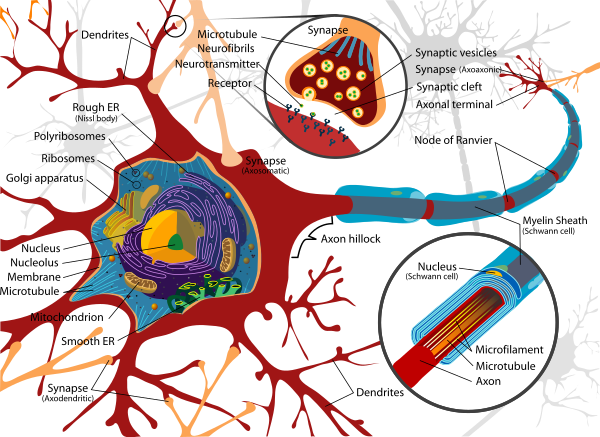
Nerve Cells

Nerve cells, also called neurons are a specialized cell found in the human body. They are a major part of the nervous system and make up nerve tissue. It has the typical organelles of a eukariotic  cell. The organelles are located in the larger part of the neuron, the cell body. The nerve cell is unique in its shape; it is longer than a typical eukariotic cell.
The nerve cell has four main parts to it: the cell body, dendrites, axon and axon terminals. The axon is covered in a lipid and protein based insulator called the myelin sheath. This makes the signals that are sent down the axon go faster and are more efficient. The purpose of the neurons is to send signals from the brain and central nervous system to the peripheral nervous system. The signals are sent from the dendrites, through the cell body and down the axon. It then goes to the axon terminals where it is transferred to the dendrites of the next neuron. The Sodium-Potassium pump assists in sending these signals down the axon. At the end, between the axon terminal of one neuron and the dendrite of the next there is a gap in between called the synaptic cleft. This is where signals and neurotransmitters are transferred through the body.