I wanted to this project because I have found that pictures can carry a story and change the way people think and view the world. I wanted to focus on the beauty in Saratoga and share it with people via the internet. My initial plan was to write captions for my pictures and go around Saratoga and to get people to focus on the nature around them. The process started out with a series of failures. Instagram was not functional on the computer I have. Then I made a Facebook account. This account was a separate account named Sara Toga. This was the height of my success. I was posting fairly regularly (for a week) and continued gaining followers. I sent out around 2000 friend requests and about half responded with at least 5 replying each day. This is when a second experiment came into my 20 time. In addition to inspiring people with photography, I wanted to see how far away I could get with a facebook account. After a few days, FB began recommending friends from different countries I continued sending requests to them. Many people blindly friended me and only a few asked who I was. Many people I did not have any mutual friends with and they still friended me. This surprised me because I have always heard about people trusting too much on the internet, but it was not until I saw it for myself that I realized how people hide behind a screen and can trust complete strangers. The page grew quickly, but the security at FB quickly noticed my unusual friending patterns and shut down my account in a week or so. I was discouraged when FB shut me down, but it did give me some hope in humanity in the sense that there is security for fake people on the internet. Coming off of this I was quite frustrated with my project. I had no way to share my pictures and I felt like I had failed the project. When I regained my motivation to continue, I created a page connected to my facebook. This challenged me because I did not want my name to be publicized on the internet. At first, only a few of my friends had seen the page. This page is much less successful than the other page because I cannot send requests to strangers. Then what I was afraid of happened: a stranger started messaging me. I dealt with this by not replying. After I leave this class I will probably discontinue my FB page, but continue to take photos. Toward the end of my project, I turned the focus from the nature in Saratoga to the Saratoga Community. I took photos at events at the High School and elementary school. This is when the story of photos came through to me. I saw how a photo can be a snapshot in time for that person and the community. In the end, I don't think I can ever 'finish' this project; new experiences and moments are happening all the time. This project introduced me to photography and I think I will continue. Looking back at photos of my childhood I see how a series of photos gives you a fuller story that lasts and I hope one day I can make a story of photos to leave behind.
The end of this project I have some photos to show for my success, but not a cohesive page of my photos. This project tried my patience and perseverance. I think I deserve an A because I challenged my comfort zone by putting pictures on the internet linked to my name. I also went out in public to take pictures which also challenged my comfort zone. I could have rebounded from my setbacks faster, but I did still come back from the FB and Instagram failures.
Here are some of the pictures I am the proudest of.
Here is the facebook page.
Ted talk outline
1. Starting goal: take photos of the community to explore beauty around us
2. FB Problems and power
3. Power of a photo
Wednesday, May 24, 2017


Sunday, May 21, 2017
River Clean Up
At the clean up we went down a trail parallel to the San Thomas Aquino River. On this trail, we picked up trash. The most common type of trash we found was chip bags and wrappers. There was a pile of garbage bags and trash caught in the bushes. In this project, I learned the power of community. An individual would have taken much longer to clean up the area, and would only be able to clean up that area. But when a community comes together this river and many others can be cleaned. The coordinator of the event said over 60 creeks are being cleaned today. This cannot be done effectively by one person, but when people unite they become more powerful and can actually make a difference.


Sunday, May 14, 2017
Unit 8 Reflection
This unit we explored the anatomy and physiology of the muscular system. The muscular system includes muscles and tendons and it works closely with the skeletal system for to achieve support and movement. The muscles are made of bundles that are also made of bundles of muscle fibers. This allows the muscle to stretch and contract. The epimysium bundles the outside of the muscle, the perimysium separates the bundles, and the endomysium contains individual muscle fibers. Fascia is throughout the muscle to help bind the fibers together. A tendon is connected to the end of the entire muscle as connects it to a bone. This allows it to move the bone. There are many different ways to move. Below is a video of the types of movements.
The movements are able to be performed due to the different types of synovial joints. The planar joint allows the bones to slide past one another, such as the carpals. The hinge joint has one bone inserted into the other and moves like a hinge. The elbow is a hinge joint. The Pivot joint has a ligament ring holding the bone in the dent, like the ulna and radius. The saddle joint has an indent like a saddle. This is found in the metacarpal of the thumb. A condyloid has an oval face that fits together and is found in the wrist. The ball and socket joint moves in many directions and is found in the hip or shoulder. The muscles that help to move our joint are named by the shape, location, movement, origin, size, and direction of fibers.
In order to contract the myosin must grab onto the actin and hold to hold the contraction. This happens when a nerve impulse comes through and Acetylcholine is released. This triggers a release of calcium ions from the sarcoplasmic reticulum into the cytoplasm. Ca2+ then binds with the troponin and opens up the binding sites also changing the troponin to tropomyosin. Then the power stroke of the myosin begins. ATP binds, then divides to ADP +P and releases energy that is used to swing the myosin head forward. P comes off and the myosin is attached to the Actin until the ADP comes off and the myosin detaches. Many heads on each myosin crawl up the until the nerve signal stops and stops the entire chain reaction.
In order to contract the myosin must grab onto the actin and hold to hold the contraction. This happens when a nerve impulse comes through and Acetylcholine is released. This triggers a release of calcium ions from the sarcoplasmic reticulum into the cytoplasm. Ca2+ then binds with the troponin and opens up the binding sites also changing the troponin to tropomyosin. Then the power stroke of the myosin begins. ATP binds, then divides to ADP +P and releases energy that is used to swing the myosin head forward. P comes off and the myosin is attached to the Actin until the ADP comes off and the myosin detaches. Many heads on each myosin crawl up the until the nerve signal stops and stops the entire chain reaction.
 |
| The structure of a muscle by its bundles. Going down drawn of a smaller level. |
The different types of muscle fibers depend on the pathways that they use for energy. Fast oxidative fibers are used for short exercise. They do not have as effective blood vessels and rely on glycogen stores. slow oxidative are used for long distance. They are red in color due to the blood vessels and fatigue slowly.
fast glycolytic are used for quick sprints. They have few blood vessels and high glycogen. They fatigue quickly.
In regards to my new year's goals, I have kept up on the relate and reviews and have not been running.
This video explains what happens after death. Muscles help us in ways we often do not realize. The earliest effects are seen when the muscles of the heart no longer pumps blood. The circulatory system relies on cardiac muscles and the skeletal muscles pumping the blood through the body. The first 1-2 minutes explain what the lack of muscles works; the second half explains more of the decomposition side of death.
Rigor mortis happens when the myosin cannot detach from the actin due to the stop of flow of ATP. Eventually, the muscles go limp after the beginnings of decay of the fibers.
Wednesday, May 10, 2017
Facebook: Pay or Get Lost
I learned that Facebook is not a very good way to spread a page if you are not willing to pay. I cannot send requests to people like a normal page can so I do not get many views. This is probably why FB does not allow companies to make an account and only permit pages. Friends are easy to get, but views are not something that can be earned for free. Now I understand how facebook can make money and not just off of adds.
Over the last few weeks, I have made a facebook group and posted my pictures to it. I have been able to write captions on a few of my pictures. The challenge I have been facing has been not having many people seeing the page. I have changed my expectations to not needing the page to grow very quickly. For the remainder of the project, I plan to take one more set of pictures and post it on FB. The final goal of this project is to spread images of nature and beauty that is around us. I hope that the people who see my photos are inspired to look around and get outside to look at the nature around us.
Over the last few weeks, I have made a facebook group and posted my pictures to it. I have been able to write captions on a few of my pictures. The challenge I have been facing has been not having many people seeing the page. I have changed my expectations to not needing the page to grow very quickly. For the remainder of the project, I plan to take one more set of pictures and post it on FB. The final goal of this project is to spread images of nature and beauty that is around us. I hope that the people who see my photos are inspired to look around and get outside to look at the nature around us.
Monday, May 8, 2017
Why We Stretch
"The proprioceptors detect any changes in physical displacement"(1).
To detect the location of limbs the body senses changes in the location of limbs. If you stimulated the muscles with an electrical signal and the person could not see, would you have a proprioception confusion?
"[stretching] helps to realign any disorganized fibers"(1)
This can help in recovery from an injury or just daily work. Daily stretching can help to keep the muscles in line and straightened out. I wonder if this would help prevent or treat knots or tightness in the muscles.
In "What Happens When You Stretch" the benefits and physiology of stretching is discussed. A stretch needs to be kept for a longer period of time to get the complete stretch. Stretching helps to align the muscles and extend the muscle fibers. The lengthening reaction takes time to happen. Stretching first extend the muscle fibers then the connective tissue. The middle part of the muscle stretches first then the edges begin to stretch when the stretch is held.
To detect the location of limbs the body senses changes in the location of limbs. If you stimulated the muscles with an electrical signal and the person could not see, would you have a proprioception confusion?
"[stretching] helps to realign any disorganized fibers"(1)
This can help in recovery from an injury or just daily work. Daily stretching can help to keep the muscles in line and straightened out. I wonder if this would help prevent or treat knots or tightness in the muscles.
In "What Happens When You Stretch" the benefits and physiology of stretching is discussed. A stretch needs to be kept for a longer period of time to get the complete stretch. Stretching helps to align the muscles and extend the muscle fibers. The lengthening reaction takes time to happen. Stretching first extend the muscle fibers then the connective tissue. The middle part of the muscle stretches first then the edges begin to stretch when the stretch is held.
Dislocated Elbow
 |
| X-ray of a dislocated elbow. This dislocation was caused by a fall from a horse. No fractures occurred. (Photo credit: Hailey Scola) |
This paper discusses the causes and possible solutions for a dislocated elbow. Dislocated elbows are common in car crashes and falls when the person lands on an arm trying to catch themselves. The first section discusses the anatomy of the elbow and how a dislocated elbow can happen. The ulna can push past the humerus and the hinge joint is unable to work properly. Additionally a possible redesign of the elbow to prevent dislocation, so the ulna can be stopped by the humerus instead of sliding past. Prevention techniques are given to prevent a dislocation in daily life. This paper is to inform about the causes and prevention of a dislocated elbow.
 |
| The anatomy of the elbow joint (915 Elbow Joint) |
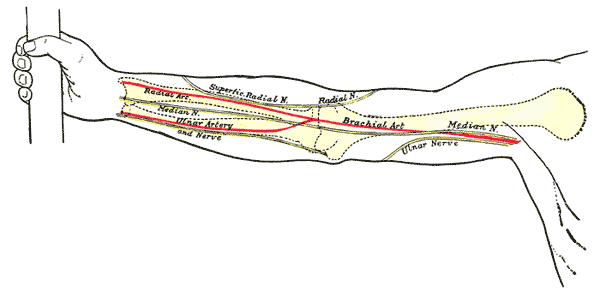 |
| Nerves and arteries in the arm. In car crashes, when the dislocation is possibly paired with fractures, these may be damaged and cause permanent damage or loss of the arm. |
The elbow is where the humerus meets the radius and ulna. I will be focusing on the humeroulnar dislocation. In a dislocation, one of the bones comes out of alignment with the humerus. This often happens when an impact to the hand of an arm that is straightened, coming from a fall or a car crash where the person puts their arms out to catch themselves. This sends a force up through the forearm that can shift the bones in the elbow. The elbow is wrapped in ligaments to help support it and keep the bones bound together. The ligaments can be damaged in a dislocation, but not always. The humeroulnar joint is a synovial hinge joint; the humerus fits into an indentation in the ulna and bends like a hinge. The synovial capsule allows the elbow to have free movement. The arm has three main nerves running down it and past the elbow: the ulnar nerve, median nerve, and the radial nerve. In some dislocations the nerves can be damaged; although, this is often paired with breaks of the arm due to severe trauma. The arm has one main artery running down it that branches into two arteries. In a severe dislocation, the blood vessels in the arm can be damaged. In these severe cases, the arm has a low chance of full recovery. The arm has the triceps and biceps brachii that extend and contract the arm respectively, the brachialis, the brachioradialis, and the Anconeus. These muscles all move the elbow and support it.
 |
| Redesigned elbow |
My redesign would switch the ends of the humerus and the ulna. The radius would go into the dent that I make on the humerus. This would help to prevent the force on the hand pushing the ulna out from under the radius. Now the ulna will be pushed and caught by the humerus in the dented end that makes up the part of the joint inserted into. This will prevent an impact from pushing the ulna past the humerus; instead, it will be caught by the indent in the humerus. I will leave the same muscles in the arm. It will still be a hinge joint and move the same way: the ulna bends and the radius rotates. The muscles help to move these bones in their normal ways of moving. Since the muscles are the same no additional blood vessels are needed. I will also keep the ligaments connecting the bones in the elbow and the radius and ulna together. The ligaments in the elbow help to connect and stabilize the joint and prevent easy dislocation. I did not increase the number of ligaments as this might interfere with the free movement of the elbow. This is an essential joint for daily life so I was not willing to sacrifice mobility for security. Ligaments still connect the radius and ulna as it gives some movement between them. Completely fusing the the two bones would limit some of the rotating movement. A problem that might arise from the new design is if the ulna is unable to push past the humerus, it might fracture the epiphysis of either bone or the shaft of the ulna. The force would go up the ulna and impact the epiphysis of the humerus. If the bones are unable to shift past one another, the impact could cause a fracture. It would probably take a larger impact to fracture the bones, but it would result in a possibly more harmful condition.
The dislocation of the ulna is usually caused by an impact to the hand from a fall or a car crash. To prevent dislocated elbows we must focus on the main cause of falling and how to prevent the fall in the first place. Even strong, coordinated people fall sometimes, so knowing how to fall properly is very important. Tucking in your arms and learning to fall and roll takes the impact off of the arms. People often try to catch the fall with their hands, but this puts the person falling at higher risk for fracturing an arm bone or dislocating an elbow. A short or gentle fall is not likely to result in a dislocation, but a hard fall or a fall from a height might dislocate the elbow. Tucking into a fall is a crucial skill because it will protect the arms, legs and the head and neck area from some damage. Many sports, such as gymnastics or football, teach athletes to fall properly to prevent injuries. Balance can be strengthened by strengthening core and leg muscles, to prevent falls too. A strong base of support keeps the person steadier and better able to stay upright. Other suggestions for prevention of a fall are to clean up spills that may cause a falling hazard. Slippery mats on tile or wood floors can slip out from under a person, causing them to fall. For older people having a seated shower or a bar to balance on in the shower is important for safety as the shower can be very slippery with the water on the tile. In addition to safe falling preventing car accidents is also an important part in preventing dislocated elbows. Safe driving and following the rules of the road. The number one cause of car accidents is from distracted driving. Distracted driving causes slower reaction times which can cause harm or death to the person distracted, the passengers or the other driver. Not all falls or car accidents can be prevented, but knowing what can contribute and result from them is important to the prevention of dislocated elbows.
A dislocated elbow must be reset by a doctor. The arm is stretched so not to fracture off any part of the bone then the humerus is placed back in the dent in the ulna. Often the arm makes a full recovery; although, physical therapy is sometimes needed to aid in the healing process and regaining full range of motion.
Works Cited
“Elbow Dislocation.” AAOS, 2007. AAOS, orthoinfo.aaos.org/topic.cfm?topic=A00029. Accessed 27 Apr. 2017.
Gray, Henry. Gray1235. 1917. Wiki Commons, commons.wikimedia.org/wiki/File:Gray1235.png. Accessed 27 Apr. 2017.
915 Elbow Joint. 13 Dec. 2013. Wikimedia Commons, commons.wikimedia.org/wiki/File:915_Elbow_Joint.jpg. Accessed 27 Apr. 2017.
“Top 25 Causes of Car Accidents.” The Law Office of Michael Pines, seriousaccidents.com/legal-advice/top-causes-of-car-accidents/. Accessed 8 May 2017.
Tortora, Gerard J. Introduction to the Human Body. New York, Wiley, 2006.
Wednesday, May 3, 2017
Chicken Dissection
| In the drumstick of the chicken are the tibia and fibula. The tibia has tendons attached to the end of it that are then attached to the muscles of the leg. When a muscle contracts, it pulls on the tendons that then move the bone. The bone is used to support the structure of the leg and aid in movement. The muscle facilitates this movement and the tendon connects the two so the muscle can move the bone. A ligament, on the other hand, connects two bones together and is used for supporting the skeleton. At the end of the bone, at the ankle, there was a cartilage cap covering it. This is to allow smooth, painless movement between bones. The origin is where the muscle starts with a tendon and is immobile. The insertion is the end of the muscle and is the end that moves. In the chicken's upper wing the biceps brachii originates from the shoulder and moves the lower arm. It inserts and moves the lower wing. On the back, the latissimus dorsi pulls the shoulders back. In Chickens and birds this aids in wing movement and flight. In humans, this would help in swimming or pull ups. Another similarity is the pectoralis major. The birds have un-proportionally large pecs, but they both aid in pushing the arms. Once again this aids in wing movement. Finally, the trapezius is similar between the two species. In birds, this is used for recovering and moving the wings in flight. In humans, it helps to shrug the shoulders.  |
| Pectoralis minor (medial)- attached to the shoulder and aids in wing movement for recovery of stroke in flight Pectoralis major(superficial)- Power flight by pulling wings |
 |
| dorsal side Trapezius (superior)- attached to shoulder and pull shoulder back and shrugs shoulders Latissimus dorsi (inferior)- connects the back to the arm. Extend the arm |
 |
| drumstick (top to bottom of picture) Gastrocnemius - extend foot, flex lower leg peroneus longus- extend foot Tibialis anterior- flex foot |
 |
| top- biceps brachii- flex bottom- triceps humeralis- extend wing forearm below- brachioradialis- retraction |
 | ||
| proximal to 'thumb' claw- flexor carpi ulnaris- flex hand proximal to that- Deltoid- raise wing
|

Subscribe to:
Comments (Atom)